
Duties of Editorial Board
Editorial Governance
Editorial Board Composition and Terms of Reference (TOR)
The Editorial Board is a core component that provides academic credibility and strategic advice.
The Editorial Board is a core component that provides academic credibility and strategic advice.
Composition: An internationally diverse group of recognised field experts with a strong interest in academic publishing. The TOR includes:
- Strategic Advice
Members advise the Editor-in-Chief (EiC) on journal policy, scope, and direction. - Content Development
Members are expected to suggest special issue topics, identify potential authors, and contribute occasional editorials or research articles. - Peer Review
Board members provide constructive suggestions to authors and may review up to two manuscripts per year. - Ambassadorship
Members promote the journal’s visibility and encourage colleagues to submit high-quality work.
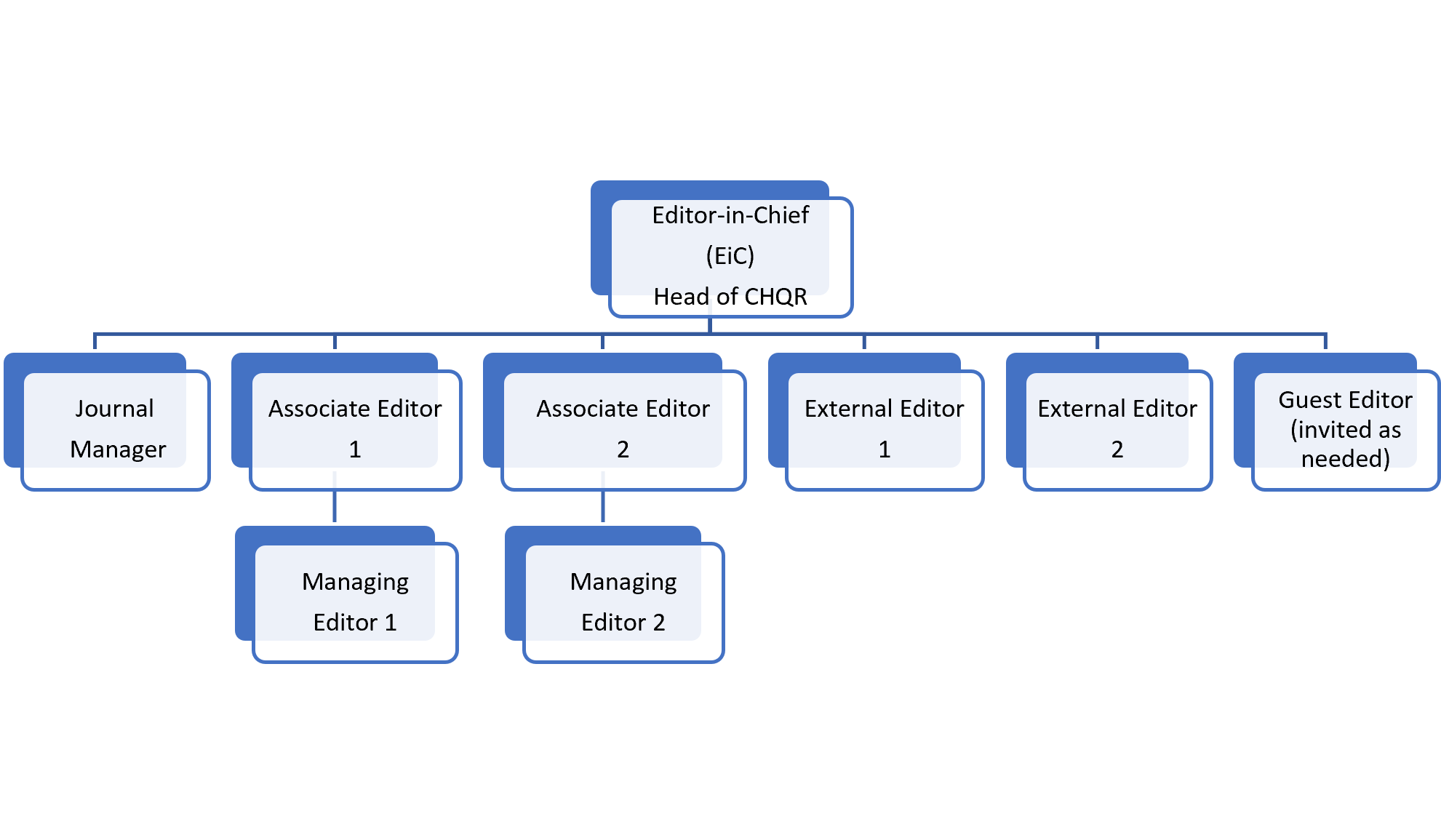
Editor-in-Chief (EiC):
The Editor-in-Chief, supported by the Associate Editors, is responsible for deciding which of the articles submitted to the journal should be published. The decision is based on the validation of the work and its importance to researchers and readers. This decision will be guided by the policies of the journal's editorial board and constrained by legal requirements regarding libel, copyright infringement, and plagiarism.
Holds final authority over all editorial content, decisions, and future strategic direction. Responsibilities include:
- Managing the day-to-day operations
- Deciding on topics, content, and contributors
- Assigning clear roles and responsibilities to team members
- Managing and maintaining the editorial board contact
- Overseeing the efficiency of the peer-review process
- Ensuring that content meets quality and ethical standards
- Ensuring that the content of contributions meets appropriate ethical requirements
- Verifying article originality
- Resolving research integrity issues
- Generating promotional ideas to increase readership
- Overseeing open science policies and data availability requirements
- Ensuring funder mandates compliance
- Leading digital transformation initiatives.
Associate Editor 1 & 2:
The Associate Editors are responsible for screening manuscripts against criteria, assigning reviewers, and monitoring research advances to ensure content sophistication. Their responsibilities include:
- Supporting the Editor-In-Chief regarding the editorial screening process
- Coordinates peer review; liaises with authors, reviewers, and board members; writes short editorials, news and research highlights; and carries out heavy developmental/technical editing of manuscripts.
- Informing the corresponding authors about the editorial decision at the end of the assessment process
- As technical editors, in reviewing and providing recommendations to assist the Editor-in-Chief in deciding upon submitted manuscripts
- Supporting the Editor-In-Chief in the identification and invitation of external reviewers for assessing manuscripts
- Supporting the Editor-In-Chief in the assessment of objective aspects of the submission assessment process
- Supporting the Editor-In-Chief in the editorial decision about publications
- Identifying integrity issues early
- Evaluating data availability statements
- Assessing research reproducibility and transparency
- Supporting the journal’s policy implementation
- Liaise with proofreaders
- Reviewing the publisher/printing company's work before printing
- Making recommendations to improve journal performance
- Ensuring that the journal remains competitive and relevant by tracking publishing trends
- Managing integrations with scholarly infrastructure (e.g. ORCID, Crossref, and others)
- Coordinating actions with indexing services
Managing Editor 1:
Technology-aware individuals focusing on logistics and author services.
- Demonstrating journal performance, indicators and agreed standards
- Total submissions
- Acceptance rate
- Time to first decision
- Review duration
- Time from submission to publication.
- Assisting the associate editor in making recommendations to improve journal performance
- Assisting the associate editor in ensuring the journal remains competitive and relevant by tracking publishing trends
Managing Editor 2:
- Coordinate communication between individual or related departments for promotional-related work, including suggesting ideas for promotional activities for Q Bulletin and its promotional materials designs for launching or attract submission
- Acquiring publication approval following the formal designated pathway
Journal manager:
- Receive submission
- Recording the submission in the Journal database
- Ensure long-term archiving and preservation
- Liaise with the publisher for designing and printing
- Q Bulletin dissemination via QHub & future platform
External Editor
Appointed board members editor outside of IHSR to provide constructive suggestions to authors and may review up to two manuscripts per year. As members, there are also responsible in promoting the journal’s visibility and encourage colleagues to submit high-quality work. They may advice in the journal’s direction and content.
Guest Editor
Experienced researchers who oversee special series or issues, compile author invitation lists, and ensure the scientific content meets the journal's standards.
Fair Play
The editor will evaluate manuscripts for their intellectual content without regard to the authors' race, gender, sexual orientation, religious belief, ethnic origin, citizenship, or political philosophy. The decision to accept or reject a paper for publication is based on the paper’s importance, originality, clarity, and the study’s validity and relevance to the journal's scope.
Confidentiality
The editor, editorial staff, and any editorial advisers must not disclose any information about a submitted manuscript to anyone other than the corresponding author, reviewers, potential reviewers, other advisers, and the publisher, as appropriate. Unpublished materials disclosed in a submitted manuscript must not be used in an editor's own research without the express written consent of the author.
Disclosure and Conflicts of Interest
Editors and editorial board members will not use unpublished information disclosed in a submitted manuscript for their own research purposes without the author's explicit written consent. Editors will recuse themselves from considering manuscripts in which they have conflicts of interest resulting from competitive, collaborative, or other relationships or connections with any of the authors, companies, or institutions connected to the papers.
Involvement and Cooperation in Investigations
The editorial board will take responsive measures when ethical concerns are raised concerning a submitted manuscript or published paper. Every reported act of unethical publishing behaviour will be looked into, even if it is discovered years after publication. Q Bulletin will follow the COPE flowcharts in dealing with suspected cases of misconduct.
Admininstrative Manager
The Q Bulletin editorial team is led by the Editor-in-Chief, supported by a Journal Manager, Associate Editors, Managing Editors, External Editors, and Guest Editors as needed.



