
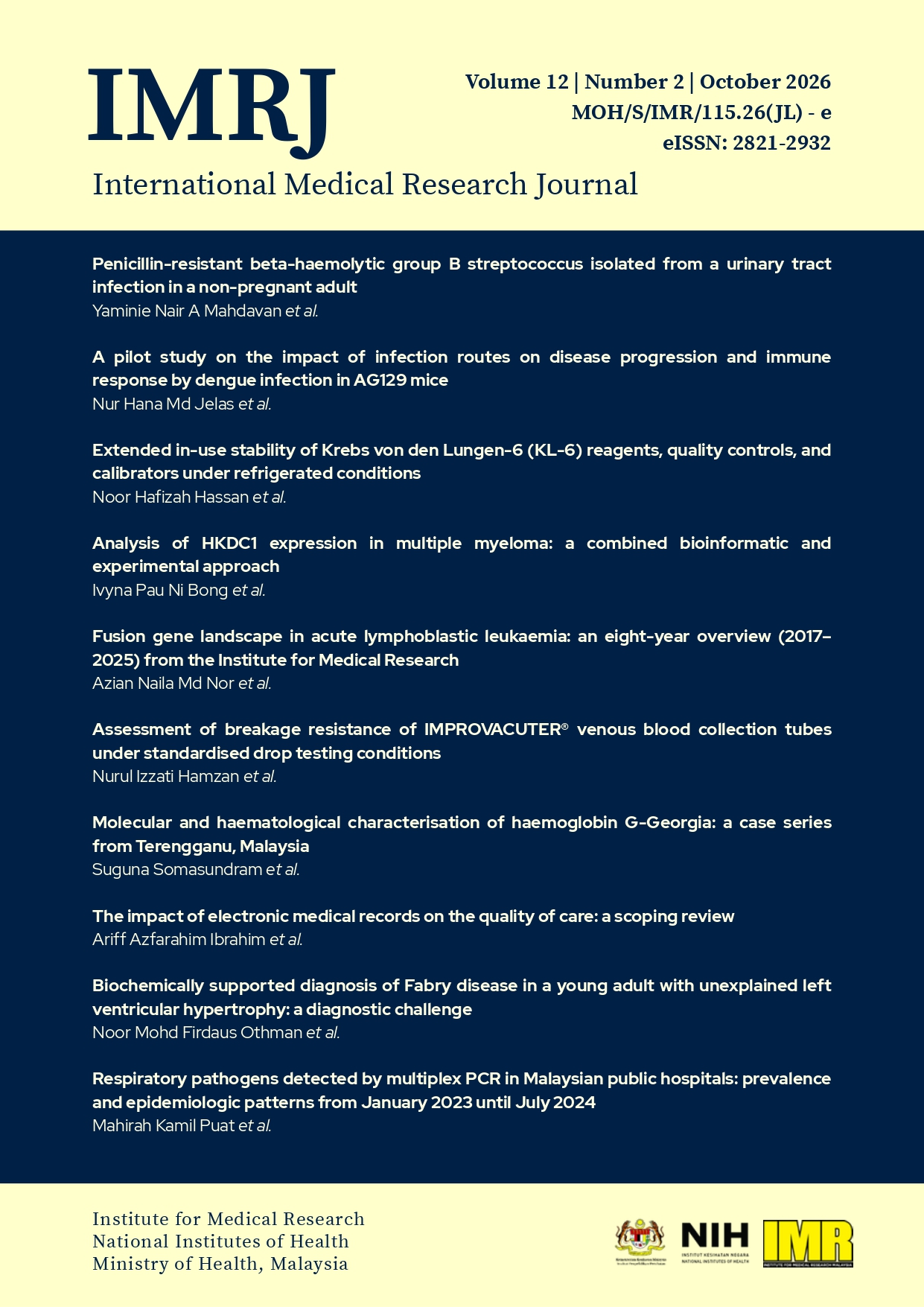
Fusion gene landscape in acute lymphoblastic leukaemia: an eight-year overview (2017-2025) from the Institute for Medical Research
DOI:
https://doi.org/10.63719/imrj.2026.12.02.005Keywords:
acute lymphoblastic leukaemia, B-ALL, T-ALL, ETV6::RUNX1, BCR::ABL1Abstract
Acute lymphoblastic leukaemia (ALL) is the most common malignancy in children, whereas adult cases are less frequent but often associated with poorer clinical outcomes. Fusion genes represent important molecular biomarkers that contribute to disease classification, risk stratification, and treatment selection. However, comprehensive data describing the molecular landscape of ALL in Malaysia remain limited. This retrospective study analysed 1253 referral samples received at the Leukaemia Translocation Laboratory, Institute for Medical Research, between 2017 and 2025. Demographic characteristics and molecular findings were evaluated. Among the patients analysed, 60.5% (n = 758) were paediatric, and 39.5% (n = 495) were adults. Male patients accounted for 58.2% of cases. The ethnic distribution comprised Malays (57.5%), Chinese (15.2%), Indians (4.6%), and other ethnicities (22.7%). Fusion genes were detected in 32.5% (n = 407) of cases, while 67.5% (n = 846) showed no detectable rearrangements. Among the fusion-positive cases, BCR::ABL1 was the most frequent abnormality (41.0%), followed by ETV6::RUNX1 (32.0%), TCF3::PBX1 (9.0%), and KMT2A::AFF1 (7.0%). BCR::ABL1 was predominantly detected in adult B-ALL, whereas ETV6::RUNX1 occurred almost exclusively in paediatric cases. Several rare rearrangements and TAL1-associated deletions were also identified, highlighting the molecular heterogeneity of ALL. Overall, these findings provide an updated overview of the fusion gene landscape in Malaysian ALL patients and emphasise the importance of molecular diagnostics in supporting accurate classification, prognostic stratification, and targeted treatment strategies.
References
Pui CH, Yang JJ, Hunger SP, Pieters R, Schrappe M, Biondi A, et al. Childhood acute lymphoblastic leukemia : Progress Through Collaboration. J Clin Oncol. 2015;33(27):2938-48. doi:10.1200/JCO.2014.59.1636.
Inaba H, Greaves M, Mullighan CG. Acute lymphoblastic leukaemia. Lancet. 2013;381(9881):1943–55. doi:10.1016/S0140-6736(12)62187-4.
Azizah AM, Hashimah B, Nirmal K, Siti Zubaidah AR, Puteri NA, Nabihah A, et al. Malaysia National Cancer Registry Report 2012–2016. Putrajaya: National Cancer Institute, Ministry of Health Malaysia; 2019.
Terwilliger T, Abdul-Hay MJ. Acute lymphoblastic leukemia : a comprehensive review and 2017 update. Blood Cancer J. 2017;7(6)e577. doi:10.1038/bcj.2017.53.
Pui CH, Evans WE. Treatment of acute Lymphoblastic leukemia. N Engl J Med. 2006;354(2):166–78. doi:10.1056/NEJMra052603.
Mullighan CG. Genomic Characterization of childhood acute lymphoblastic leukemia. Semin Hematol. 2013;50(4):314–24. doi:10.1053/j.seminhematol.2013.10.001.
Bhojwani D, Yang JJ, Pui CH. Biology of childhood acute lymphoblastic leukemia. Pediatr Clin North Am. 2015;62(1):47-60. doi:10.1016/j.pcl.2014.09.004.
Li S, Ye J, Meng FY, Li C, Yang M. Clinical characteristics of acute lymphoblastic leukemia in male and female patients : a retrospective analysis of 705 patients. Oncol Lett. 2015;10(1):453–8. doi: 10.3892/ol.2015.3202.
Janardan SK, Miller TP. Adolescents and young adults (AYAs) vs pediatric patients: survival, risks, and barriers to enrollment. Hematology. 2023;2023(1):581–6. doi:10.1182/hematology.2023000507.
Pessoa FMC de P, de Oliveira MB, Barreto IV, Machado AK da C, Oliveira DS de, Ribeiro RM, et al. Nested-PCR vs. RT-qPCR: A sensitivity comparison in the detection of genetic alterations in patients with acute leukemias. DNA. 2024;4(3):285–99. doi:10.3390/dna4030019.
Brihi JE, Pathak S. Normal and abnormal complete blood count with differential [Internet]. www.ncbi.nlm.nih.gov. StatPearls Publishing; 2024 [cited 2026 May 6]. Available from: https://www.ncbi.nlm.nih.gov/books/NBK604207/.
Puckett Y, Chan O. Acute lymphocytic leukemia (ALL) [Internet]. Nih.gov. StatPearls Publishing; 2023 [cited 2026 May 6]. Available from: https://www.ncbi.nlm.nih.gov/books/NBK459149/.
Amini M, Sharma R, Jani C. Gender differences in leukemia outcomes based on health care expenditures using estimates from the GLOBOCAN 2020. Arch Public Healh. 2023;81(1):151. doi: 10.1186/s13690-023-01154-8.
Patel M, Zabor EC, Mohamed A, Ali MKM. Clinical presentation and survival outcomes of B cell versus T cell Acute lymphoblastic leukemia. JAPA Academy Journal. 2026;4(1):30–5. doi:10.4103/JAPAJ.JAPAJ_62_25.
AL- Mahdawi FK, Mohammed MR. Acute lymphoblastic leukemia, classification, clinical features, and diagnosis types of acute leukemia lymphoblastic leukemia acute leukemia classification of ALL. Diyala Journal of Medicine. 2020;19(2):59-65. doi:10.26505/DJM.19025390602.
Tasian SK, Boer JM, den Boer ML. From the bench of molecular understanding to the bedside of optimal therapy for BCR::ABL1 and ABL-class acute lymphoblastic leukemia in children and adolescents. EJC Paediatr Oncol. 2025;6:100304. doi:10.1016/j.ejcped.2025.100304.
Fan R, Zhao M, Li P, Tian Y, Liu B, Zhu X, et al. Clinical characteristics and prognostic analysis of different fusion gene abnormalities in childhood acute lymphoblastic leukaemia. Front Oncol. 2025;15:1616686. doi:10.3389/fonc.2025.1616686.
Moorman AV, Ensor HM, Richards SM, Chilton L, Schwab C, Kinsey SE, et al. Prognostic effect of chromosomal abnormalities in childhood B-cell precursor acute lymphoblastic leukaemia : results from the UK Medical Research Council ALL97/99 randomised trial. Lancet Oncol. 2010;11(5):429–38. doi:10.1016/S1470-2045(10)70066-8.
Moorman AV.The clinical relevance of chromosomal and genomic abnormalities in B-cell precursor acute lymphoblastic leukaemia. Blood Rev. 2012;26(3):123–35. doi:10.1016/j.blre.2012.01.001.
Roberts KG. Genetics and prognosis of ALL in children vs adults. Hematol 2014, the American Society of Hematology Education Program Book. 2018;2018(1):137–45. doi:10.1182/asheducation-2018.1.137.
Thomas X. Small molecule menin inhibitors: novel therapeutic agents targeting acute myeloid leukemia with KMT2A rearrangement or NPM1 mutation. Oncol Ther. 2024;12(1):57–72. doi:10.1007/s40487-024-00262-x.
Sun J, Yu W, Zhang X. MENIN inhibitor-based therapy in acute leukemia: latest updates from the 2024 ASH annual meeting. Exp Hematol Oncol. 2025;14(1):78. doi:10.1186/s40164-025-00668-x.
Thielemans N, Mentens N, Gielen O, Provost S. TAL1 cooperates with PI3K/AKT pathway activation in T-cell acute lymphoblastic leukemia. Haematologica. 2022;107(10):2304–17. doi:10.3324/haematol.2021.279718.
Kim HY, Kim B, Park MS, Park JH, Ju HY, Yoo KH, et al. Detection of fusion genes using RNA sequencing in acute leukemia. Ann Lab Med. 2026;46(3):257–69. doi:10.3343/alm.2025.0300.
Chen X, Wang F, Zhang Y, Wang M, Tian W, Teng W, et al. Retrospective analysis of 36 fusion genes in 2479 Chinese patients of de novo acute lymphoblastic leukemia. Leuk Res. 2018;72(6):99–104. doi: 10.1016/j.leukres.2018.08.009.
Downloads
Published
Issue
Section
License
Copyright (c) 2026 Azian Naila Md Nor, Nor Rizan Kamaluddin, Ezalia Esa, Suguna Somasundram, Norafiza Mohd Yasin, Ermi Neiza Mohd Sahid, Nurul Aqilah Ali, Siti Nornazihah Mohd Rosdi, Rafizie Rafiq Adha Mat Kamal, Noraizan Ahmad, Zahidah Abu Seman, Nadirah Zainal Abidin, Yuslina Mat Yusoff (Author)

This work is licensed under a Creative Commons Attribution 4.0 International License.



