Peer Review Process

Peer Review Process
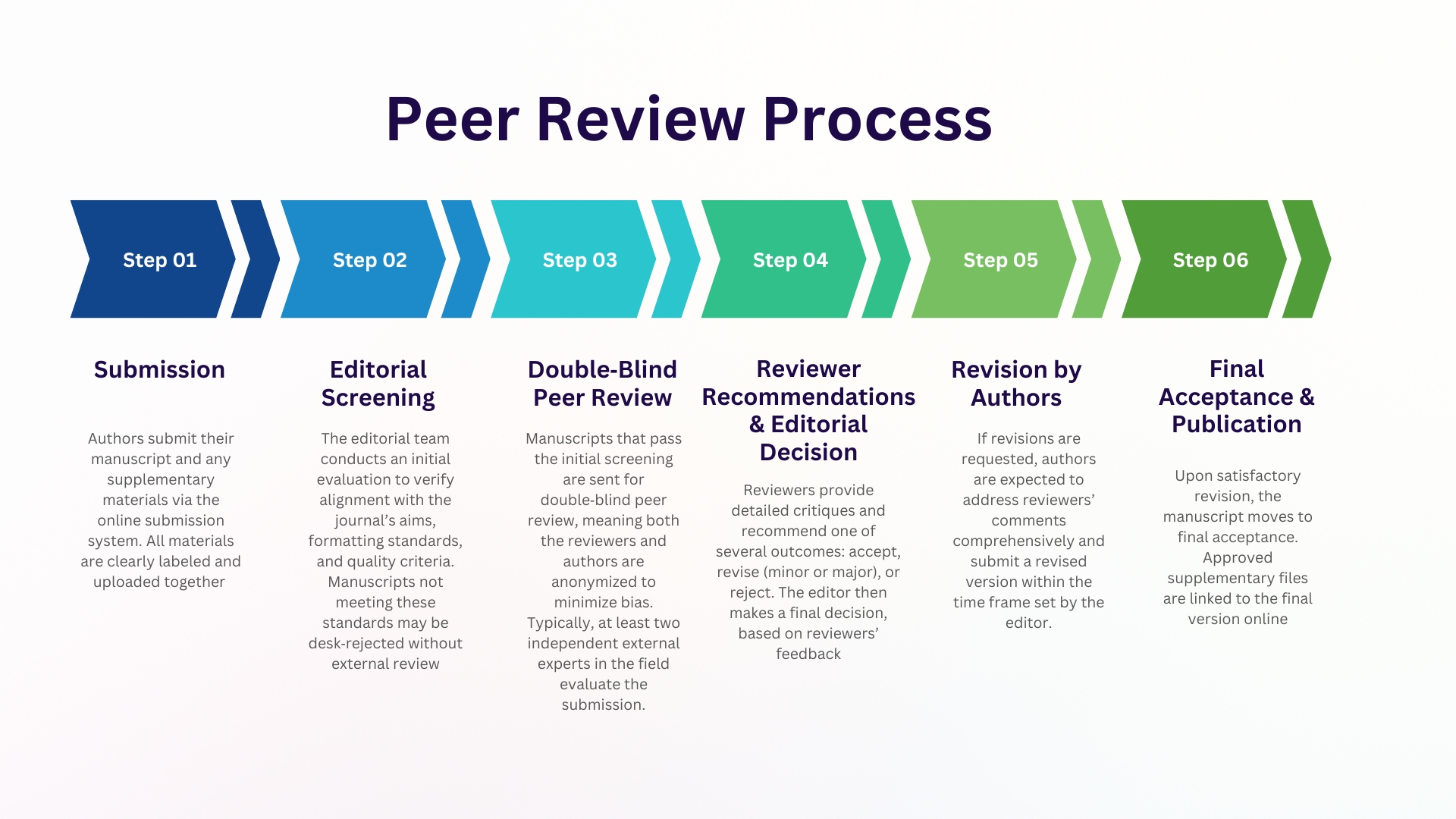
The Peer Review Process is the cornerstone of ensuring the quality and integrity of published work. This process includes thorough evaluations, starting from new manuscript submissions to peer reviews and editorial decisions. Each stage, including revisions and final acceptance, is designed to uphold the highest standards of scholarly excellence. Post-acceptance, the publication process ensures that the final output is polished and impactful. By following this rigorous process, the journal guarantees that only the most credible and well-developed manuscripts are published, reinforcing its commitment to advancing knowledge and maintaining academic integrity.
 
01   New Manuscript Submission

Manuscripts should be submitted exclusively through the journal's online submission system. Once received, each submission undergoes an initial screening to ensure:

  • Compliance with guidelines: The manuscript adheres to the journal's preparation requirements.
  • Relevance: The content aligns with the journal's aim and scope.
  • Originality: The submission is not a pre-printed version.
  • Quality check: The similarity index remains below 20%.

Submissions that fail to meet these standards are promptly declined, ensuring only the most suitable papers move forward for detailed review.

02   Peer Review
  • IMRJ practices a double-blind peer review policy, where both authors and reviewers remain anonymous.
  • The Editorial Board may exercise its prerogative to reject a manuscript without peer review if that article is judged to be outside the scope of the Journal, poorly written or formatted, or lacking in significance.
  • During submission, authors may specify any editors or reviewers to exclude from reviewing their manuscript. The journal will honour these requests if they do not hinder an objective review.
  • The handling editor selects reviewers based on expertise and invites them to review the manuscript.
03   Quality of Review

IMRJ practices a double-blind peer review policy, where both authors and reviewers remain anonymous.

The Editorial Board may exercise its prerogative to reject a manuscript without peer review if that article is judged to be outside the scope of the Journal, poorly written or formatted, or lacking in significance.

Manuscripts received by The Journal will be evaluated by the Editorial Board, which will judge whether they are of potential interest to readers of The Journal. Manuscripts that are of interest, formatted according to the guidelines for Authors and presented fairly well are then sent to the Section Editor for further assignment of reviewers.

Typically, two reviewers are assigned for manuscript review. Peer reviewers will be asked to submit their reports via our secure online system. Manuscripts may be sent to other specialised experts, such as experts in statistics or a particular technique, where a scientist with expertise in that particular technique is needed to evaluate the manuscript.

Reviewers are assessed on the quality of review and other performance characteristics by the Editor-in-Chief to assure optimal journal quality and performance. These ratings should also contribute to decisions on reappointment to The Journal’s Editorial Board and to ongoing review requests. Individual performance data on Reviewers are available to the Editor-in-Chief but otherwise kept confidential.

Reviews are expected to be professional, honest, courteous, prompt, and constructive. A good review includes the following inputs from the reviewers:

  • Comment on major strengths and weaknesses of the manuscript, independent of the design, methodology, results, and interpretation of the study.
  • Identify and comment on major strengths and weaknesses of the experimental design and characterization methods.
  • Comment accurately and constructively on the quality of the Author’s interpretation of the data, including acknowledgment of its limitations.
  • Comment on any ethical concerns raised by the study, or any possible evidence of substandard scientific conduct.
  • Provide the Authors with useful suggestions to improve the manuscript.
  • Comments should be constructive and personal comments regarding the Authors are not permitted.
  • Comment on the work.
  • Provide the Editor-in-Chief with the proper context and perspective to make a recommendation on the acceptability of the manuscript.

During submission, authors may specify any editors or reviewers to exclude from reviewing their manuscript. The journal will honour these requests if they do not hinder an objective review.

The handling editor selects reviewers based on expertise and invites them to review the manuscript.

04   Editorial Decisions
  • If the editor sees publication potential but requests changes, authors will have 14 days to resubmit the revised manuscript, whether for major or minor revisions.
  • Revised manuscripts typically go back to the original editor, who may decide based on the revisions and responses to reviewers or seek further input from external reviewers.
  • A request for an extension has to be sent via email to imrjournal@moh.gov.my .
For Revised Manuscripts, Upload the Following Items:
  • Response to Reviewers: Address each reviewer’s and editor’s comments, listing changes made.
  • Revised Manuscript (Marked-Up Copy): Submit a version with changes highlighted, ideally using “Track Changes” in Word. Upload as “Revised Article with Changes Highlighted.”
05   Revisions
  • The handling editor makes the final decision on each manuscript based on review completion.
  • The editor considers reviewer feedback and their assessment, with possible decisions being: Reject, Major Revision, Minor Revision, or Accept.
  • The decision and reviewer feedback are sent to the corresponding author in a formal letter, along with any additional requirements via email.
06   Accepted Manuscripts
  • IMRJ has two levels of acceptance. First, the editor issues an editorial acceptance decision once satisfied with the manuscript’s scientific quality. This provisional acceptance depends on meeting final formatting and technical requirements.
  • Once these are met, the journal office sends a formal acceptance decision, and the manuscript proceeds to production.
07   Post-Acceptance / Publication

All articles published in IMRJ are licensed under the Creative Commons Attribution 4.0 International License.

You are free to:
  • Share — copy and redistribute the material in any medium or format for any purpose, even commercially.
  • Adapt — remix, transform, and build upon the material for any purpose, even commercially.
Under the Following Terms:
  • Attribution — You must give appropriate credit, provide a link to the license, and indicate if changes were made. You may do so in any reasonable manner, but not in any way that suggests the licensor endorses you or your use.
  • No additional restrictions — You may not apply legal terms or technological measures that legally restrict others from doing anything the license permits.
08   Withdrawal

Withdrawing a manuscript after acceptance is considered poor publication practice, as it disregards the significant time and effort invested by editors and reviewers in refining your work. Furthermore, once a manuscript is published, withdrawal is strictly prohibited to uphold the integrity of the publication process.

09   Author Responsibility

Authors are responsible for the correctness of the statements provided in the manuscript.

10   Editorial Authority

The Editor-in-Chief reserves the right to reject submissions that do not meet the guidelines described in this section.

11   Disclaimer / Publisher’s Note

The statements, opinions, and data contained in all publications are solely those of the individual author(s) and contributor(s) and not of IMRJ and/or the editor(s). IMRJ and/or the editor(s) disclaim responsibility for any injury to people or property resulting from any ideas, methods, instructions, or products referred to in the content.