
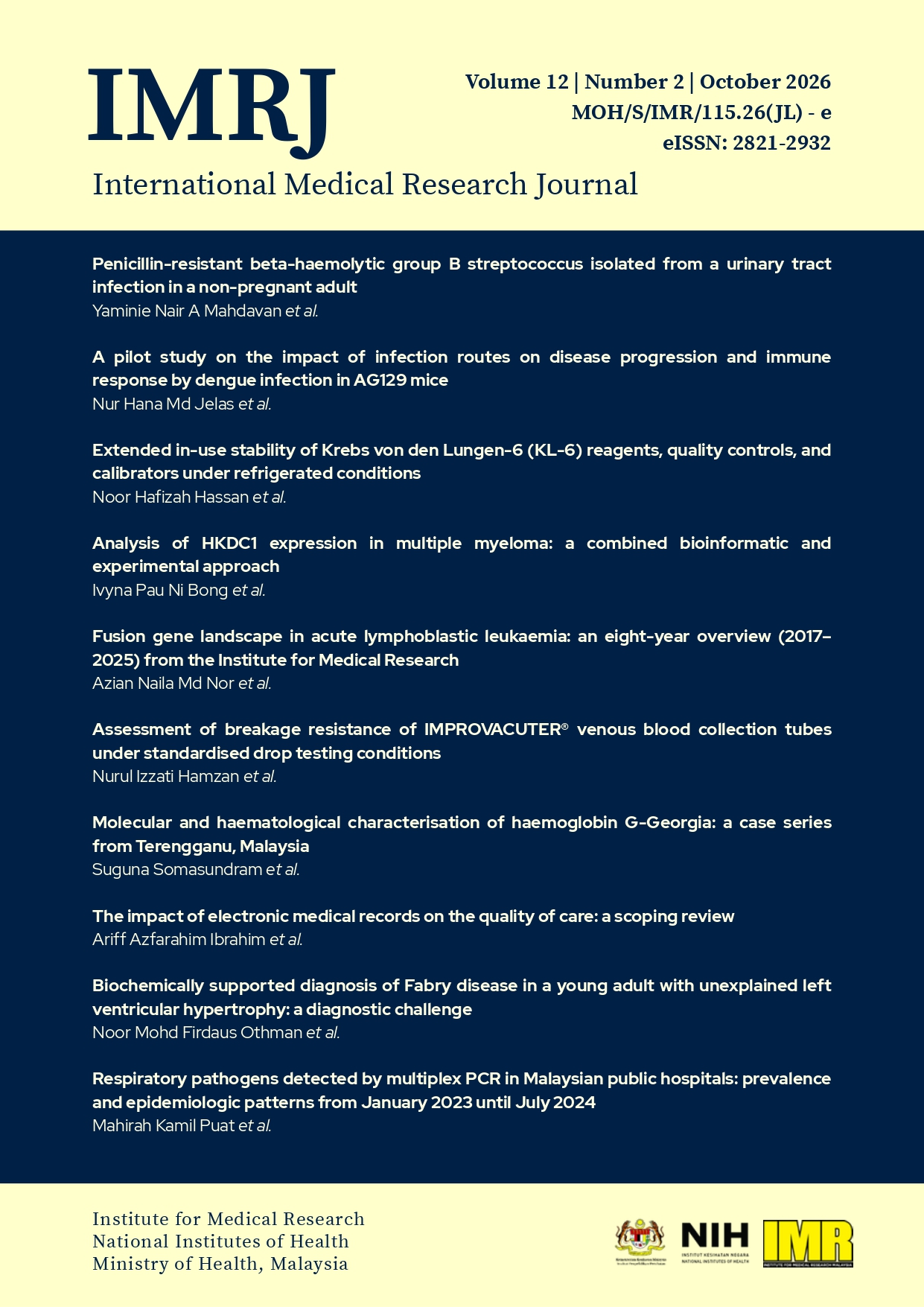
Respiratory pathogens detected by multiplex PCR in Malaysian public hospitals: prevalence and epidemiologic patterns from January 2023 until July 2024.
DOI:
https://doi.org/10.63719/imrj.2026.12.02.010Keywords:
respiratory tract infections, multiplex PCR, rhinovirus/enterovirus, respiratory syncytial virus, epidemiologyAbstract
Respiratory tract infections remain an important cause of hospitalisation and diagnostic uncertainty, and multiplex polymerase chain reaction testing offers rapid detection of multiple pathogens in routine clinical practice. We aimed to describe the prevalence, demographic associations, and temporal trends of respiratory pathogens detected by the QIAstat-Dx Respiratory SARS-CoV-2 Panel in Malaysian public hospitals. This multicentre retrospective cross-sectional study included nasopharyngeal swab samples from cases with suspected acute respiratory infections tested between 1 January 2023 and 31 July 2024. Data were collected from participating sites using standardised record forms and analysed. We assessed overall positivity, pathogen frequencies, age-group and regional distributions, and monthly and quarterly trends. A total of 8,361 samples were included, of which 5,252 (62.8%) had at least one pathogen detected. Single detections were identified in 4,279 samples (51.2%), while co-detections were observed in 973 samples (11.6%). Viral pathogens predominated. Rhinovirus/enterovirus was the most frequently detected pathogen (23.8%), followed by respiratory syncytial virus A/B (13.7%) and influenza A H1N1/2009 (4.8%). Positivity was highest among children aged 1 to 4 years and infants aged 1 to 11 months, and age-related variation was more pronounced than regional variation. The leading pathogens also demonstrated distinct temporal profiles, with different peak months across the study period. In conclusion, respiratory pathogen detection in this hospital-based population was characterised by a high positivity rate, predominance of viral pathogens, marked age-related differences, and distinct temporal patterns. These findings support the value of multiplex PCR for respiratory pathogen surveillance in Malaysian public hospitals.
References
GBD 2021 Lower Respiratory Infections and Antimicrobial Resistance Collaborators. Global, regional, and national incidence and mortality burden of non-COVID-19 lower respiratory infections and aetiologies, 1990-2021: a systematic analysis from the Global Burden of Disease Study 2021. Lancet Infect Dis. 2024;24(9):974-1002. doi:10.1016/S1473-3099(24)00176-2.
Khales P, Razizadeh MH, Ghorbani S, Moattari A, Saadati H, Tavakoli A. Prevalence of respiratory viruses in children with respiratory tract infections during the COVID-19 pandemic era: a systematic review and meta-analysis. BMC Pulm Med. 2025;25:135. doi:10.1186/s12890-025-03587-z.
Huang HS, Tsai CL, Chang J, Hsu TC, Lin S, Lee CC. Multiplex PCR system for the rapid diagnosis of respiratory virus infection: systematic review and meta-analysis. Clin Microbiol Infect. 2018;24(10):1055-63. doi:10.1016/j.cmi.2017.11.018.
Clark TW, Lindsley K, Wigmosta TB, Bhagat A, Hemmert RB, Uyei J, et al. Rapid multiplex PCR for respiratory viruses reduces time to result and improves clinical care: results of a systematic review and meta-analysis. J Infect. 2023;86(5):462-75. doi:10.1016/j.jinf.2023.03.005.
QIAGEN. QIAGEN broadens syndromic testing menu in Malaysia with the MDA approval of advanced QIAstat-Dx respiratory panel [Internet]. Venlo: QIAGEN N.V.; 2024 Jun 4 [cited 2026 Sep 16]. Available from: https://corporate.qiagen.com/English/newsroom/press-releases/press-release-details/2024/QIAGEN-broadens-syndromic-testing-menu-in-Malaysia-with-the-MDA-approval-of-advanced-QIAstat-Dx-respiratory-panel/default.aspx
Contier J, Platon L, Benchabane N, Tchakerian S, Herman F, Mollevi C, et al. Diagnostic performance of pneumonia multiplex PCR in critically ill immunocompromised patients. Crit Care. 2025;29:310. doi:10.1186/s13054-025-05528-y.
Popova G, Jakjovska T, Arnaudova-Danevska I, Boskovska K, Smilevska Spasovska O. Multiplex PCR in diagnosing respiratory tract infections in hospitalized children. Contrib Sec Med Sci. 2024;45(1):61-68. doi: 10.2478/prilozi-2024-0007.
Tai IH, Hsiao CT, Chu CH, Tsai WJ, Chen YJ, Wu HP. Co-detection of various viruses in SARS-CoV-2 in children with respiratory infections. Sci Rep. 2025;15:8312. doi:10.1038/s41598-025-92878-w.
Ruivo AP, Bauermann MDC, Gregianini TS, dos Santos FM, Godinho F, Baethgen LF, et al. Surveillance of respiratory viruses in severe acute respiratory infections in Southern Brazil, 2023-2024. BMC Infect Dis. 2025;25:1163. doi:10.1186/s12879-025-11458-5.
Norton JM, Dashler G, Klein E, Mostafa HH. The utility of syndromic respiratory pathogen panels: the premise of flexible and customizable approaches. J Clin Microbiol. 2025;63(7):e00313-25. doi:10.1128/jcm.00313-25.
Low YL, Wong SY, Lee EKH, Muhammed MH. Prevalence of respiratory viruses among paediatric patients in acute respiratory illnesses in Malaysia. PLoS One. 2022;17(8):e0265288. doi:10.1371/journal.pone.0265288.
Yew SM, Tan KL, Yeo SK, Ng KP, Kuan CS. Molecular epidemiology of respiratory viruses among Malaysian young children with a confirmed respiratory infection during 2014–2015. J Thorac Dis. 2019;11(11):4626–4633. doi:10.21037/jtd.2019.10.69.
Peñarrubia L, Rao SN, Porco R, Varo M, Muñoz-Torrero P, Ortiz-Martinez F, et al. Detecting zoonotic Influenza A using QIAstat-Dx Respiratory SARS-CoV-2 panel for pandemic preparedness. Sci Rep. 2023;13:2833. doi:10.1038/s41598-023-29838-9.
Centers for Disease Control and Prevention. Types of influenza viruses [Internet]. Atlanta (GA): Centers for Disease Control and Prevention; 2025 Sep 26 [cited 2026 Sep 7]. Available from: https://www.cdc.gov/flu/about/viruses-types.html
Matsumura Y, Yamamoto M, Tsuda Y, Shinohara K, Tsuchido Y, Yukawa S, et al. Epidemiology of respiratory viruses according to age group, 2023-24 winter season, Kyoto, Japan. Sci Rep. 2025;15:924. doi:10.1038/s41598-024-85068-7
Duan Y, Liu Z, Zang N, Cong B, Shi Y, Xu L, et al. Landscape of respiratory syncytial virus. Chin Med J (Engl). 2024;137(24):2953-78. doi:10.1097/CM9.0000000000003354.
Fu B, Wu Z, Huang L, Chai Z, Zheng P, Sun Q, et al. A comparison of demographic, epidemiological and clinical characteristics of hospital influenza-related viral pneumonia patients. BMC Infect Dis. 2021;21:1002. doi:10.1186/s12879-021-06485-x.
Shi T, Huang L. Prevalence of respiratory pathogens and risk of developing pneumonia under non-pharmaceutical interventions in Suzhou, China. Epidemiol Infect. 2023;151:e82. doi:10.1017/S0950268823000626.
Mohammadi K, Faramarzi S, Yaribash S, Valizadeh Z, Rajabi E, Ghavam M, et al. Human metapneumovirus (hMPV) in 2025: emerging trends and insights from community and hospital-based respiratory panel analyses-a comprehensive review. Virol J. 2025;22:150. doi:10.1186/s12985-025-02782-y.
Chan PWK, Chew FT, Tan TN, Chua KB, Hooi PS. Seasonal variation in respiratory syncytial virus chest infection in the tropics. Pediatr Pulmonol. 2002;34(1):47–51. doi:10.1002/ppul.10095.
Khor CS, Sam IC, Hooi PS, Quek KF, Chan YF. Epidemiology and seasonality of respiratory viral infections in hospitalized children in Kuala Lumpur, Malaysia: a retrospective study of 27 years. BMC Pediatr. 2012;12:32. doi:10.1186/1471-2431-12-32.
Chan CM, Wahab AA, Ali A. Determining the relationship of meteorological factors and severe pediatric respiratory syncytial virus infection in Central Peninsular Malaysia. Int J Environ Res Public Health. 2023;20(3):1848. doi:10.3390/ijerph20031848.
Sam IC, Noraini W, Sandhu SS, Norizah I, Selvanesan S, Thayan R, et al. Seasonal influenza activity based on laboratory surveillance in Malaysia, 2011–2016. J Med Virol. 2019;91(3):498–502. doi:10.1002/jmv.25313.
Chow WZ, Chan YF, Oong XY, Ng LJ, Nor'E SS, Ng KT, et al. Genetic diversity, seasonality and transmission network of human metapneumovirus: identification of a unique sub-lineage of the fusion and attachment genes. Sci Rep. 2016;6:27730. doi:10.1038/srep27730.
Teoh Z, Conrey S, McNeal M, Burrell A, Burke RM, Mattison CP, et al. Factors associated with prolonged respiratory virus detection from polymerase chain reaction of nasal specimens collected longitudinally in healthy children in a US birth cohort. J Pediatric Infect Dis Soc. 2024;13(3):189–195. doi:10.1093/jpids/piae009.
Berry GJ, Jhaveri TA, Larkin PMK, Mostafa H, Babady NE . ADLM guidance document on laboratory diagnosis of respiratory viruses. J Appl Lab Med. 2024;9(3):599–628. doi:10.1093/jalm/jfae010.
Downloads
Published
Issue
Section
License
Copyright (c) 2026 Mahirah Kamil Mahirah Kamil Puat, Valerie Ting Siau Mei, Hafzan Baharim, Amizah Othman, Dayangku Seritul Akmar Abd Razak, Aliah Abdul Rahman, Fatimah Haslina Abdullah, Siti Hawa Hamzah, Aniz Suriani Mohd Ali, Yuhin Karina Yusoff, Zahrul Laili Abd Hadi, Hazilawati Hussin, Noor Hasliza Zainol, Nurul Azira Sidek, Edahayati Ahmad Tajudin, Norafandi Mohd Noor, Mohammad Faisol Hamdi Omar, Muhammad Faiz Mohd Ali, Anis Roziana Mohmad, Jayamalar Pitchaimuthu, Norhafez Senon, Nurhafiza Ishak, Chu Lee Hwa, Syaziah Ibrahim, Mohd Khairul Izzati Omar, Sairina Mosiun, Hanis Syazwani Mohd Hassan, Nadiyah Abdullah @ Azahari, Amira Amir, Sharifah Saidah Syed Omar, Anusia Muthusamy, Nor Zanariah Zainol Abidin, Padmaloseni Thangarajah, Rayuwani Mohamad Kamal, Sahlawati Mustakim (Author)

This work is licensed under a Creative Commons Attribution 4.0 International License.



