
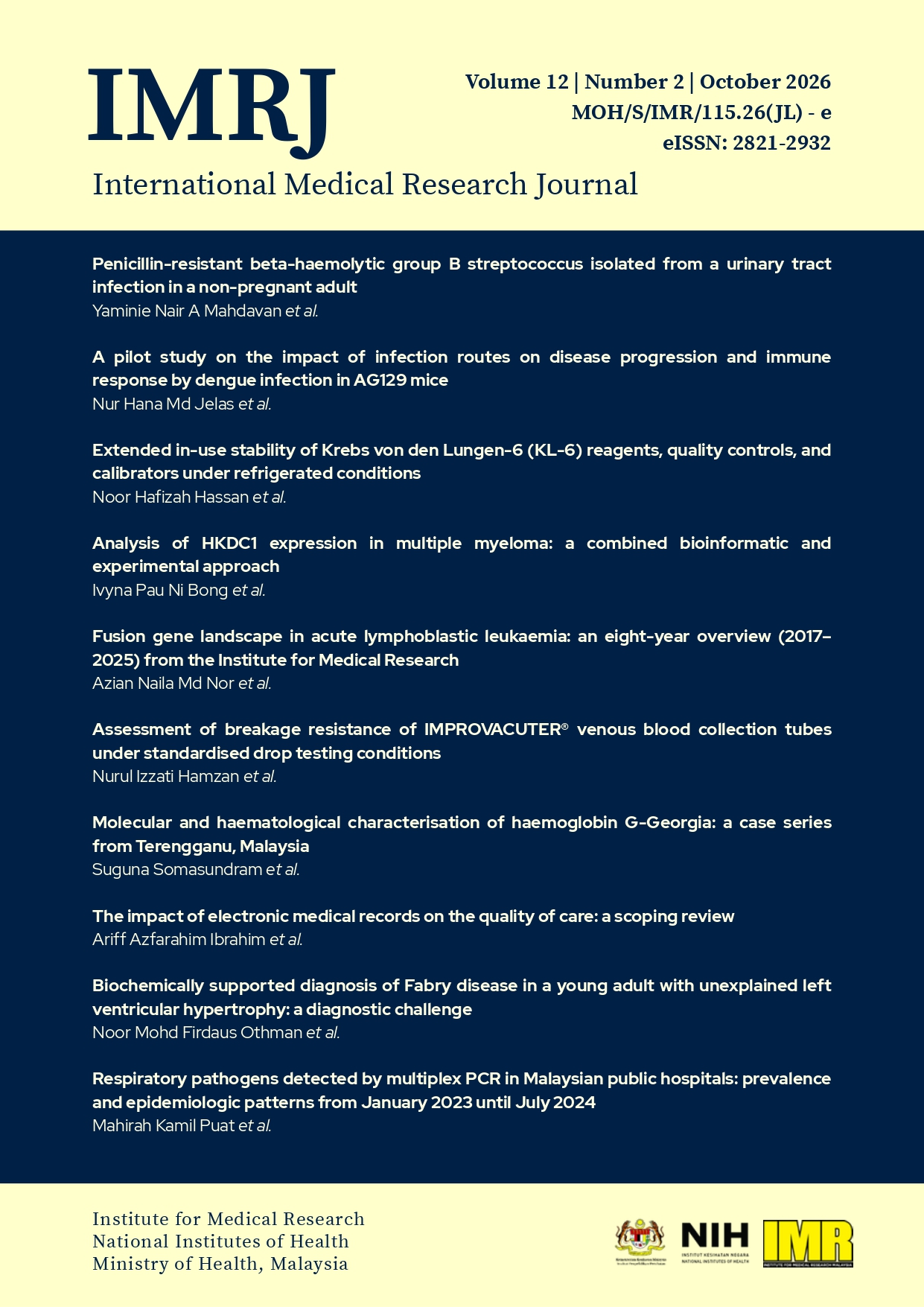
Assessment of breakage resistance of Improvacuter® venous blood collection tubes under standardised drop testing conditions
DOI:
https://doi.org/10.63719/imrj.2026.12.02.006Keywords:
blood collection tubes, breakage resistance, mechanical stress, IMPROVACUTER®Abstract
Blood collection tubes are integral to diagnostic workflows but are routinely exposed to mechanical stress during handling, transportation, and routine laboratory processing. Structural failure of these tubes may result in specimen loss and pose potential biohazard risks to healthcare personnel. This standards-based verification study evaluated the breakage resistance of six categories of IMPROVACUTER® venous blood collection tubes. A total of 108 tubes from three independent manufacturing lots were filled to their nominal draw volumes and subjected to a standardised 1 m drop test, with three consecutive drops per tube onto a concrete surface. Following testing, tubes were inspected for visible cracks, leakage, breakage, or cap dislodgement. Evaluation criteria were based on ISO 6710:2017 and ISO 2859-1 (AQL 1.5), with a predefined practical acceptance criterion of at least 90% passing per tube category. The overall pass rate was 94.4% (102/108; 95% CI, 88.3%–97.9%). Citrate tubes achieved a 100% pass rate, while Gel & Clot Activator, EDTA K2, Heparin, and Glucose tubes each demonstrated a 94.4% pass rate. Clot Activator tubes showed a pass rate of 88.9%. These findings indicate high breakage resistance under the standardised drop-test conditions evaluated; other performance characteristics were not assessed.
References
Bowen RA, Remaley AT. Interferences from blood collection tube components on clinical chemistry assays. Biochem Med (Zagreb). 2014;24(1):31-44
Clinical and Laboratory Standards Institute. Collection of Diagnostic Venous Blood Specimens. GP41-Ed7. Wayne, PA: CLSI; 2017.
International Organization for Standardization. ISO 6710:2017: Single-use containers for human venous blood specimen collection. Geneva: ISO; 2017.
Lippi G, Chance JJ, Church S, et al. Preanalytical quality improvement: from dream to reality. Clin Chem Lab Med. 2011;49(7):1113–26.
McCall RE, Tankersley CM. Phlebotomy Essentials. 7th ed. Burlington, MA: Jones & Bartlett Learning; 2020.
Nell EM, Bailly J, Oelofse D, Linström M, Opie J, Chapanduka ZC, Vreede H, Korf M. Multicentre verification of haematology laboratory blood collection tubes during a global blood collection tube shortage. Int J Lab Hematol. 2023;45(5):707-716.
Kratz A, Stanganelli N, Van Cott EM. A comparison of glass and plastic blood collection tubes for routine and specialized coagulation assays: a comprehensive study. Arch Pathol Lab Med. 2006;130(1):39-44
World Health Organization. WHO Guidelines on Drawing Blood: Best Practices in Phlebotomy. Geneva: WHO; 2010.
International Organization for Standardization. ISO 2859-1:2026. Sampling procedures for inspection by attributes — Part 1: Sampling schemes indexed by acceptance quality limit (AQL) for lot-by-lot inspection. Geneva: ISO; 2026
Simundic AM, et al. Joint EFLM-COLABIOCLI Recommendation for venous blood sampling. Clin Chem Lab Med. 2018;56(12):2015–2038.
Downloads
Published
Issue
Section
License
Copyright (c) 2026 Nurul Izzati Hamzan, Cefefe Stephany Jolin, Muhammad Nursyazwan Zamre, Fadzlyasraf Shaari, Syarifah Nurhikmah Izzati Syed Nasarudin, Noor Hafizah Hassan, Siti Nurwani Ahmad Ridzuan (Author)

This work is licensed under a Creative Commons Attribution 4.0 International License.



