
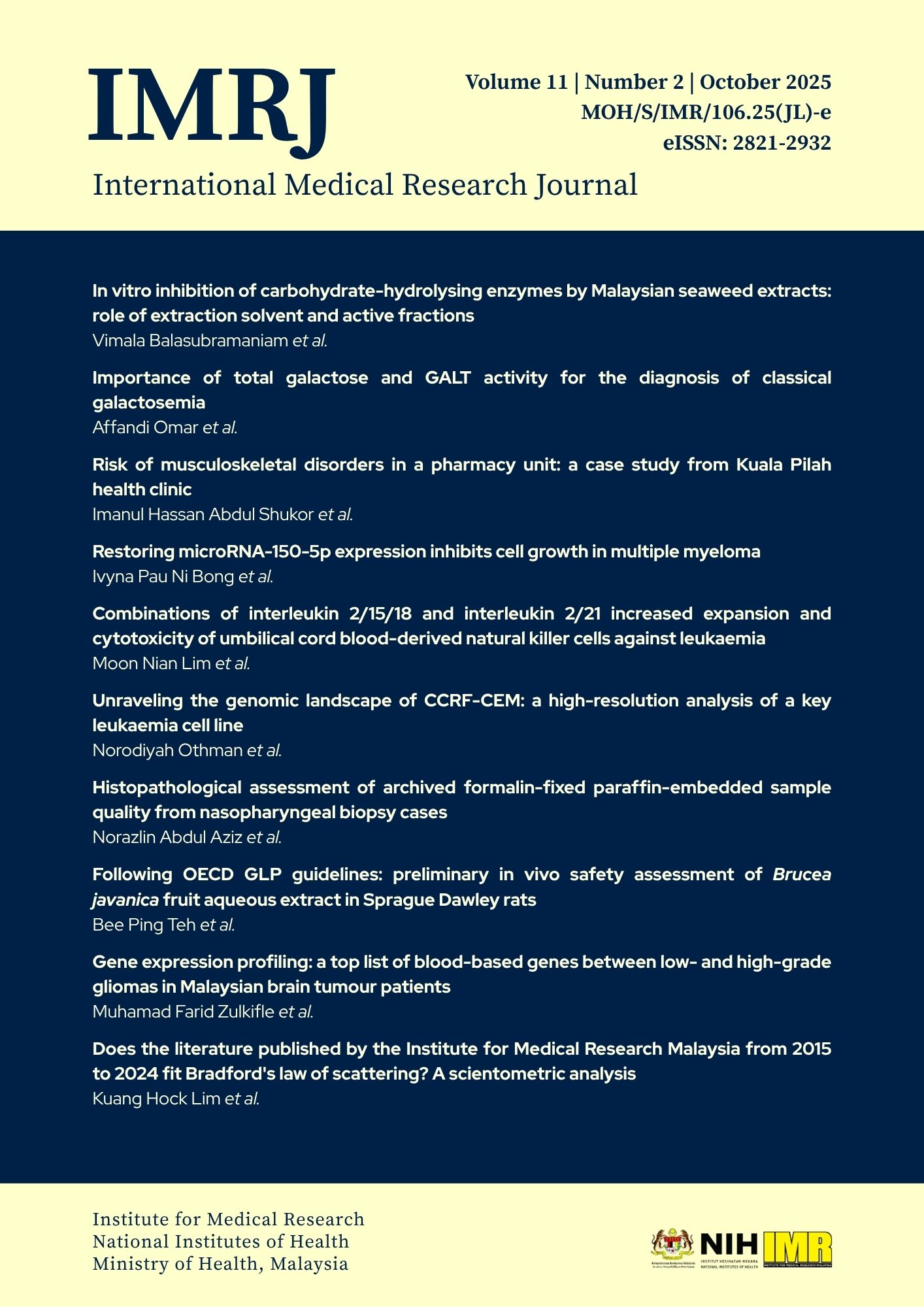
In vitro inhibition of carbohydrate-hydrolysing enzymes by Malaysian seaweed extracts: role of extraction solvent and active fractions
DOI:
https://doi.org/10.63719/imrj.2025.11.02.001Keywords:
Malaysian seaweed, α-amylase inhibition, α-glucosidase inhibition, Eucheuma denticulatum, diabetes managementAbstract
Marine macroalgae or seaweeds, traditionally consumed in coastal regions, are rich in bioactive compounds with potential therapeutic benefits. This study investigated the inhibitory effects of ethanolic and methanolic extracts from three locally available edible seaweeds, namely Eucheuma denticulatum, Sargassum polycystum, and Caulerpa lentillifera, against α-amylase and α-glucosidase, key enzymes involved in postprandial glucose regulation in type 2 diabetes mellitus. Crude extracts were prepared using ethanol or methanol (1:20 w/v, 24 h maceration with stirring at room temperature), followed by in vitro enzyme assays using porcine pancreatic α-amylase and yeast α-glucosidase. Among the methanolic extracts, E. denticulatum exhibited the highest α-amylase inhibition (50% at 10 mg/mL), while the ethanolic extract inhibited 67%. S. polycystum and C. lentillifera showed moderate to low inhibition across both solvent extractions. The half maximal inhibitory concentration (IC₅₀) of ethanolic E. denticulatum extract was 1.99 mg/mL, indicating a potent inhibitory effect. Further fractionation of the ethanolic extract revealed that the ethyl acetate fraction had the strongest α-amylase inhibitory activity (49%), followed by acetone (42%) and hexane (36%), though all were lower than the crude extracts, suggesting possible synergistic interactions among the bioactive constituents. In contrast, none of the seaweed extracts exhibited notable α-glucosidase inhibition. These findings highlight the importance of solvent selection in extracting bioactive compounds and support the potential application of E. denticulatum, particularly its semi-polar constituents, as a promising candidate for functional food or nutraceutical applications that help regulate carbohydrate metabolism.
References
American Diabetes Association. Standards of medical care in diabetes. Diabetes Care. 2006;29(Suppl 1): S4–42.
World Health Organization. World Health Organization. 2024. Diabetes.
Guo H, Wu H, Li Z. The Pathogenesis of Diabetes. Vol. 24, International journal of molecular sciences. NLM (Medline); 2023.
MacArtain P, Gill CIR, Brooks M, Campbell R, Rowland IR. Nutritional value of edible seaweeds. Nutr Rev. 2007;65(12 Pt 1):535–43.
Koru E, Kılınç B, Turan G, Cirik S, Tekogul H. Seaweeds for Food and Industrial Applications. In: Muzzalupo I, editor. Food Industry [Internet]. Rijeka: IntechOpen; 2013. Available from: htps://doi.org/10.5772/53172
Susilowati ND, Lia Kusmita LK, Sulistyowati E. The Effect of Different Extraction Methods of Sargassum polycystum Pigments on Antioxidant and Anti-Obesity Activities in Vitro. International Journal of Pharmaceutical Research and Applications. 2024 May;09(05):728–33
Matanjun P, Mohamed S, Mustapha NM, Muhammad K, Ming CH. Antioxidant activities and phenolics content of eight species of seaweeds from north Borneo. J Appl Phycol. 2008;20:367–73.
Matanjun P, Mohamed S, Mustapha NM, Muhammad K. Nutrient content of tropical edible seaweeds, Eucheuma cottonii, Caulerpa lentillifera and Sargassum polycystum. J Appl Phycol [Internet]. 2009;21(1):75–80. Available from: htp://link.springer.com/10.1007/s10811-008-9326-4
Sharma BR, Rhyu DY. Anti-diabetic effects of Caulerpa lentillifera: stimulation of insulin secretion in pancreatic β-cells and enhancement of glucose uptake in adipocytes. Asian Pac J Trop Biomed [Internet]. 2014;4(7):575–80. Available from: htp://www.pubmedcentral.nih.gov/articlerender. fcgi?artid=4032834&tool=pmcentrez&rendertype=abstract
Balasubramaniam V, Lee JC, Noh MFM, Ahmad S, Brownlee IA, Ismail A. Alpha-amylase, antioxidant, and anti-inflammatory activities of Eucheuma denticulatum (N.L. Burman) F.S. Collins and Hervey. J Appl Phycol. 2016;28(3).
Pacheco D, Araujo G, Silva J, Cotas J, Gonçalves A, Pereira L. Red Seaweeds: Their Use in Formulation of Nutraceutical Food Products. In 2022. p. 253–65
Maser WH, Maiyah N, Nagarajan M, Kingwascharapong P, Senphan T, Ali AMM, et al. Effect of different extraction solvents on the yield and enzyme inhibition (α-amylase, α-glucosidase, and lipase) activity of some vegetables. Biodiversitas. 2023;24(6):3320–31
Del Pilar Fernández-Poyatos M, Ruiz-Medina A, Zengin G, Llorent-Martinez EJ. Phenolic characterization, antioxidant activity, and enzyme inhibitory properties of Berberis thunbergii DC. Leaves: A valuable source of phenolic acids. Molecules. 2019 Nov 17;24(22)
Lee JE, Jayakody JTM, Kim JI, Jeong JW, Choi KM, Kim TS, et al. The influence of solvent choice on the extraction of bioactive compounds from Asteraceae: a comparative review. Foods. 2024;13(19):3151
Yildirim B, Yilmaz MA, Zengin G, Genc H. Phytochemical compositions, antioxidant properties, enzyme inhibitory effects of extracts of four endemic Lathyrus L. taxa from Türkiye and a taxonomic approach. Acta Bot Brasilica. 2023;37.
Nisar J, Shah SMA, Akram M, Ayaz S, Rashid A. Phytochemical Screening, Antioxidant, and Inhibition Activity of Picrorhiza kurroa Against α-Amylase and α-Glucosidase. Dose-Response. 2022 Apr 1;20(2)
Matos J, Cardoso C, Serralheiro ML, Bandarra NM, Afonso C. Seaweed bioactives potential as nutraceuticals and functional ingredients: A review. Journal of Food Composition and Analysis [Internet]. 2024; 133:106453. Available from: htps://www.sciencedirect.com/ science/article/pii/S0889157524004873
Lomartire S, Gonçalves AMM. An overview of potential seaweed-derived bioactive compounds for pharmaceutical applications. Mar Drugs. 2022;20(5):319. doi:10.3390/md20050319
Balasubramaniam V, Mustar S, Mustafa Khalid N, Abd Rashed A, Mohd Noh MF, Wilcox MD, et al. Inhibitory activities of three Malaysian edible seaweeds on lipase and α-amylase. J Appl Phycol. 2013;25(5):1405–12
Balasubramaniam V, June Chelyn L, Vimala S, Mohd Fairulnizal MN, Brownlee IA, Amin I. Carotenoid composition and antioxidant potential of Eucheuma denticulatum, Sargassum polycystum and Caulerpa lentillifera. Heliyon [Internet]. 2020;6(8):e04654. Available from: htps://doi.org/10.1016/j.heliyon.2020.e04654
Koodkaew I, Pitakwongsaporn S, Jarussophon N, Wichachucherd B. Chemical Profile, Antioxidant Activity and α-Glucosidase Inhibition of Sea Grape Caulerpa lentillifera Collected from Different Sites in Thailand. Trends in Sciences. 2024 Apr 1;21(4)
Lim PE, Tan J, Phang SM, Nikmatullah A, Hong DD, Sunarpi H, et al. Genetic diversity of Kappaphycus Doty and Eucheuma J. Agardh (Solieriaceae, Rhodophyta) in Southeast Asia. J Appl Phycol. 2013;1–20.
Mattio L, Payri CE, Verlaque M. Taxonomic revision and geographic distribution of the subgenus sargassum (FUCALES, PHAEOPHYCEAE) in the western and central pacific islands based on morphological and molecular analyses. J Phycol. 2009;45(5):1213–27
Subramanian R, Asmawi MZ, Sadikun A. In vitro α-glucosidase and α-amylase enzyme inhibitory effects of Andrographis paniculata extract and andrographolide. Acta Biochim Pol. 2008;55(2):391–8
Nasab SB, Homaei A, Pletschke BI, Salinas-Salazar C, Castillo-Zacarias C, Parra-Saldívar R. Marine resources effective in controlling and treating diabetes and its associated complications. Vol. 92, Process Biochemistry. Elsevier Ltd; 2020. p. 313–42
Iwai K. Antidiabetic and Antioxidant Effects of Polyphenols in Brown Alga Ecklonia stolonifera in Genetically Diabetic KK-A y Mice. Plant Foods Hum Nutr. 2008; 63:163–9
Nwosu F, Morris J, Lund V a., Stewart D, Ross H a., McDougall GJ. Anti-proliferative and potential anti-diabetic effects of phenolic-rich extracts from edible marine algae. Food Chem [Internet]. 2011;126(3):1006–12. Available from: http://linkinghub.elsevier.com/retrieve/pii/S0308814610015293
Payghami N, Jamili S, Rustaiyan A, Saeidnia S, Nikan M, Gohari AR. Alpha-amylase inhibitory activity and sterol composition of the marine algae, Sargassum glaucescens. Pharmacognosy Res. 2015 Oct 1;7(4):314–21
Ryu JW, Lee MS, Yim MJ, Lee JM, Lee DS, Kim YM, et al. α-amylase and α-glucosidase inhibition effects of Korean edible brown, green, and red seaweed extracts. Fish Aquatic Sci. 2023;26(3):181–7
Downloads
Published
Issue
Section
License
Copyright (c) 2025 Vimala Balasubramaniam, Mohd Fairunizal Mohd Noh, Amin Ismail (Author)

This work is licensed under a Creative Commons Attribution 4.0 International License.



